Fri Dec 15 2023
Developed for a Procedural Content Generation course, Roll For Dungeon is a physical, dice-driven D&D 5e dungeon crawl booklet: 12 room tiles and 8 pathway tiles with nearly three million possible combinations, generated at the table roll by roll.
Written by: DarthPackman
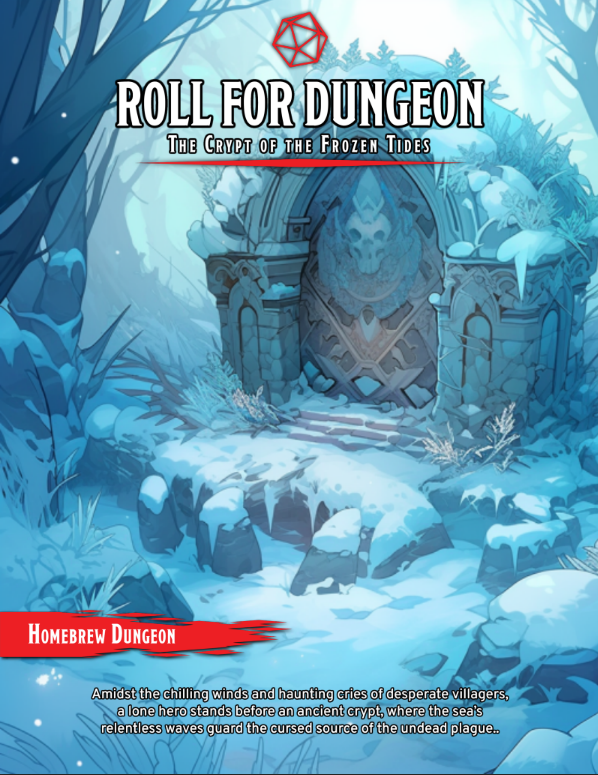
Roll For Dungeon: The Crypt of the Frozen Tides was developed for an advanced procedural content generation course as a physical, printable take on PCG: a dice-driven D&D 5th Edition dungeon crawl. Rather than generating content in code, the “algorithm” runs at the table — the Dungeon Master rolls a d12 to pick from 12 base rooms, then a d8 for each of three connecting pathways, before rolling into one of 12 themed boss rooms to close out the run. Between the room and pathway variations, the system supports nearly three million possible dungeon layouts.
The booklet frames all of this inside a specific setting: a frigid coastal region where fishing villages are being terrorized by an undead plague traced back to an ancient crypt, giving every randomly assembled dungeon a consistent narrative hook.
As a class project where the goal was testing a PCG system rather than shipping a polished commercial product, art generation leaned on Midjourney and some text drafting leaned on ChatGPT — a deliberate tradeoff given the scope of a solo, non-artist, non-author student project. Any future commercial version of Roll For Dungeon would replace those pieces with original art and writing.
Roll For Dungeon successfully demonstrates procedural content generation applied outside a digital context, using structured randomness, dice mechanics, and modular tile design to give every table a differently shaped dungeon without requiring any prep time from the DM.
You can view and download the full rulebook here.